

Compliments, comments, and complaints
We are committed to providing excellent service and welcome feedback from all our service users, commissioners, and those who may be affected by our services.
The Compliments, Suggestions, and Complaints Policy outlines the steps and considerations taken for submitting feedback. Our Compensation policy informs users on the procedures undertaken to secure any compensation regarding their claim.
Whether you’ve had a positive experience with our services, think that we need to change our approach, or have any suggestions on how our services could be improved, we want to hear from you.
It’s through this collaboration that we’re able to support our service users and the communities we work within.
Reporting antisocial behaviour
If you have concerns about antisocial behaviour (ASB) or neighbour nuisance issues, you can record these on our ASB form.
How to make a compliment, comment, or complaint
You can contact your service contact or centre staff directly to share your feedback. Alternatively, you can complete our online form below.
Choose the category that best describes you from the drop down below, and complete the form. We aim to respond to queries within five working days.
Housing complaints annual reports
As part of our commitment to improving the quality of our services, our annual reports provide transparency to the challenges raised and the actions taken.
1. Purpose
To provide an overview of the complaints received in Housing, including numbers, nature, and response times.
To provide assurance to Executive Leadership Team and the Board of Trustees of appropriate complaint handling and implementation of lessons learned.
Provide the opportunity to scrutinise complaint service improvement plans.
2. Annual Figures
2.1 Number of complaints
| Quarter 1 2023_24 | Quarter 2 2023_24 | Quarter 3 2023_24 | Quarter 4 2023_24 |
| 30 | 37 | 16 | 31 |
2.2. Exclusions
All housing complaints were accepted and responded to.
2.3. Complaint response performance
| Q1 | Q2 | Q3 | Q4 | |
| No. of complaints acknowledged within 5 working | 70% (21) | 75% (28) | 69% (11) | 72% (22) |
| No. of complaints resolved within 10 working days | 30% (9) | 25% (9) | 50% (8) | 48% (15) |
3. Nacro’s Compliments, Comments and Complaints Policy
Our full policy is available here, on our website, alongside our Compensation Policy.
Policy summary:
If a compliment or comment is raised, Nacro will respond within five days to acknowledge the feedback and thank the submitter for getting in touch.
For complaints, Nacro have a two-stage process.
A complaint is an expression of dissatisfaction, however made, with the standard of Nacro’s service, actions, or lack of action could reasonably be expected of Nacro, or those acting on its behalf, affecting an individual resident or group of residents or students.
This could include:
- Failure to follow up or notify the Service User about appropriate action following initial contact.
- Failure or lengthy delay in providing a service or to take an action which Nacro said they could provide or take.
- Failure to comply with a policy.
- The inappropriate behaviour of Nacro employees or contractor.
Stage one
Nacro will acknowledge the complaint within five working days. The manager for the service will investigate and provide a written response within 10 working days.
If a complainant is dissatisfied with Nacro’s response at stage one, they can request for their complaint to be handled at the next stage. Nacro will always speak to the complainant to understand what parts of the complaint response they are dissatisfied with, and what actions they are looking for to resolve the issue.
Stage two
An acknowledgement letter will be sent within five working days of receipt of the stage two complaint. The complaint will be referred for review to a more senior manager. This could be an area manager, the head of service or centre manager. They will investigate and a written response will be provided within 20 working days.
Promoting the policy: A new complaints policy leaflet has been created, see below. This is shared with service users in welcome packs and displayed in services.
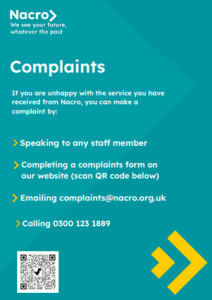
When the Nacro website was upgraded, a new pro-forma was added to make it easier for complaints to be made and received by Nacro. The complaints mailbox is monitored daily to ensure swift responses to complaints. The QR code on the poster directs to the pro-forma on the website, to enable easy access.
4. Complaint topics and trends
The complaints from service users mainly related to the service they received. These centred around:
- Staff members available and responsiveness.
- Tenants dissatisfied in how a procedure has been applied or alleging it has been applied incorrectly.
- Property condition and repairs
Areas of housing complaints
| Region | Number of annual complaints |
| Essex and London | 3 |
| Lincolnshire | 4 |
| Midlands | 18 |
| North and East England | 12 |
| North West | 16 |
| Wales | 7 |
There were three services with a higher-than-average number of complaints. The two services with the most complaints relate to staff members responsiveness. The management team are aware of these issues, both through complaints and other performance reporting, and have put in place management plans to respond to the concerns highlighted.
Anti-social behaviour
Most complaints coming via the Nacro website are categorised on our website as being received from a ‘Member of Public’ and tend to be reports of anti-social behaviour.
A report of anti-social behaviour is not a complaint. This is because they are not a complaint about a service Nacro provide or are in direct control of. However, we understand the distressing impact anti-social behaviour can have, for our tenants and neighbours, and we want to proactively resolve any issues reported to us.
We know that we have an important role in addressing anti-social behaviour and must work effectively with our partner agencies such as the Police and the Local Authority to resolve these issues. We recognise that where reports of anti-social behaviour relate to tenancy matters, we have a larger role to play in resolving them and want to do our upmost to ensure that we are a good neighbour. Because of this, we often accept reports of anti-social behaviour as complaints and respond to them in this way.
Guaranteeing that we fulfil our responsibilities and find resolution for both complaints and antisocial behaviour is a priority for Nacro, and the section below outlines new resources we have committed to ensure we can respond appropriately to anti-social behaviour.
5. Service improvements as the result of complaints:
These are the measures that have been put in place throughout the year as themes and issues were highlighted through complaints.
Recording and record keeping:
- Timely responses – to support effective and timely complaint resolution, the Quality and Safeguarding team have begun monthly audits of complaint handling to address any issues that have arisen in that month.
- New, external training around complaints handling has been procured from the Housing Quality Network.
- The online complaints form has been updated to ensure all relevant information is captured.
- A housing complaints improvement plan in place to monitor performance against the complaint handling code.
Housing management:
- Occupancy sustainment training, which includes management of arrears, former tenant arrears and ending a tenancy is being rolled out to all teams.
- We have enhanced our capacity and skills to respond to anti-social behaviour, including training for teams on responding to and tackling anti-social behaviour.
- A new Anti-social behaviour policy and procedure is in place to support teams to respond.
- New anti-social behaviour expertise/personnel has been introduced into the Housing Management team to support operational teams to manage incidents as they arise.
Property Condition:
- We have increased the resources in the property maintenance team to support increased post-repair inspections.
- We have reviewed and improved the system to ensure property repairs that the head landlord (not Nacro) is responsible for, are recorded accurately and completed in a timely fashion.
6. Nacro’s plans for service improvements in 2024/25:
As a result of this annual review and our ongoing complaint improvement plan, we have committed to the following measures.
Ease of making a complaint:
- New, advertised complaint number with embedded QR code.
- Improved website pro-forma.
- Launch a new complaints leaflet.
Quality assurance:
- Nacro wide complaint improvement plan with responsibility shared between the housing and Chief Executives office.
- One complaint policy for all Nacro services (housing, justice & health, and education services)
- Complaint policy peer reviewed by the Housing Quality Network.
- The Quality and Safeguarding team to actively manage and support all live complaints being responded to locally.
7. Compensation
The Compensation Policy was new in February 2024 and has been applied four times to date. Three occasions were to tenants.
8. Staff training
New staff training has been procured from the Housing Quality Network, to upskill our teams in responding to complaints, with a focus on staff members resolving the issues raised and rebuilding the relationship of trust with the service user.
All staff briefings on the new complaints policy are taking place across 2024/25 Q2.
9. Regulatory updates
Complaints made about our accommodation services are governed by the Housing Ombudsman Service. Through the new RSH Consumer Standards, their complaint handling code is now on a statutory footing. We have demonstrated our compliance with the code in the self-assessment document that is here, on our website.
Our Compliments, Comments and Complaints Policy has been updated to ensure it reflects the Housing Ombudsman’s expectations.
To meet the new requirements, we now have a Trustee responsible for complaints – Philippa Oldmeadow. The Head of Quality and Safeguarding and Head of Executive Office will be meeting with her at least quarterly between Executive Leadership Team and the Board of Trustees to review our performance.
Our poor performance in responding to complaints in a timely fashion is our biggest risk of non-compliance with the Housing Ombudsman’s expectations. We recognise improvement is needed in this area, while previous improvement attempts have not had the outcomes desired. The Quality and Safeguarding team are working with the CEO Office to jointly drive service improvements. We will be reporting to the Executive team on our progress.
No complaints have been referred to the Housing Ombudsman in the period.
10. 2024/25 Reporting
From 1st April 2024 the follow KPIs will be to be reported to Executive Leadership Team and the Board of Trustees:
- (For context, not KPI) Stage 1: number of complaints:
- Percentage of stage one complaints acknowledged within 5 days.
- Percentage of stage one complaints responded to within 10 days.
- (For context, not KPI) Stage 2: number of complaints escalated to stage 2
- Percentage of stage two complaints responded to within 20 days.
This quarterly report will be expanded to include complaints from Justice and Health services and Education. This report will be brought to Executive Leadership Team and the Board of Trustees (and the Education Committee).
A comment from our board
This report outlines a positive baseline for Nacro’s management of housing complaints; however, we know that there is work to do. We are committed to listening to, and positively resolving, the concerns shared with us by our tenants, neighbours and wider stakeholders and will continue to work closely with them to drive improvements and best practise with regards to our complaints management.
In year, we have rolled out a new complaints policy and procedure, implemented several improvement activities and undertaken a thorough self-assessment against the Housing Ombudsman’s complaint handling code which has formed the basis of our complaints improvement plan.
We have additional development activity planned for the 24/25 financial year which we are confident will further improve our complaints handling and enhance the quality of our reporting.
This annual report provides a thematic overview of complaints received across Nacro Housing services during 2024/25. It sets out the volume and nature of complaints, response times, and the lessons learned.
It also reflects on how complaints have shaped improvements in practice, culture, and service delivery. This ensures transparency, supports scrutiny by the Executive Leadership Team (ELT) and Board of Trustees, and demonstrates our compliance with the Housing Ombudsman’s Complaint Handling Code.
Nacro have had an increased focus on complaints for the last 18 months, both in terms of encouraging receipt of them through clear central channels and upskilling our front-line teams to welcome and embrace complaints and feedback, and in strengthening mechanisms for tracking and management of complaint handling.
Whilst the former has been effective, and we have seen a significant rise in complaints; mechanisms we have embedded to strengthen our ability to manage them within the expected timescales have not proven to be effective due to the continued reliance on front line operational managers with multiple competing priorities.
Reflecting on the full year’s performance, there have been marginal improvements in housing performance, however there is clearly still work to do to ensure that complaint handling is better managed within expected timescales. On a positive note, complaints proportionate to the volume of service users remain low with less than 5% of residents reporting any complaints. Likewise, the number of complaints which progress to stage 2 is also low (9%) suggesting that the quality of responses at stage 1 is sufficient to address the complainant’s concerns.
It’s fair to say that 2024/25 has been a year of learning and challenge. Complaints have highlighted recurring issues around timeliness, property standards, and consistency of support. Importantly, they have also driven tangible improvements in processes, training, and service delivery. As we move into 2025/26, our focus is on embedding a culture of accountability, ensuring complaints are resolved quickly and fairly, and using learning to improve outcomes for all residents.
Nacro’s Compliments, Comments and Complaints Policy
Our full policy is available here, on our website, alongside our Compensation Policy. The complaints definition and two-stage process are aligned to the Ombudsman’s expectations.
Annual Figures
3.1. Number of stage 1 complaints
| Quarter 1 2024_25 | Quarter 2 2024_25 | Quarter 3 2024_25 | Quarter 4 2024_25 | Total |
| 17 | 42 | 33 | 43 | 135 |
3.2. Stage 1 complaints outcomes
| Complaint upheld | Complaint partially upheld | Complaint not upheld | Total |
| 32 | 21 | 21 | 74* |
*This is not 100% of all complaints. These numbers reflect centrally recorded outcomes. In 2025/26 increased monitoring of outcomes centrally will improve completeness of reporting.
3.3. Number of stage 2 complaints
| Quarter 1 2024_25 | Quarter 2 2024_25 | Quarter 3 2024_25 | Quarter 4 2024_25 | Total |
| 2 | 5 | 1 | 4 | 12 |
3.4. Stage 2 complaints outcomes
| Complaint upheld | Complaint partially upheld | Complaint not upheld | Total |
| 1 | 6 | 5 | 12 |
3.5. Exclusions
All housing complaints were accepted and responded to.
3.6. Complaint response performance
| Measure | Performance |
| No. of stage 1 complaints acknowledged within 5 working | 73% (98) |
| No. of complaints responded to within 10 working days | 47% (64) |
| No. of stage 2 complaints acknowledged within 5 working | 75% (9) |
| No. of stage 2 complaints responded to within 20 working days | 67% (8) |
Complaint trends
Accessibility and Timeliness
Performance against complaint response standards was mixed. Of stage 1 complaints, 73% were acknowledged on time, but only 47% received a response within 10 days. At stage 2, 75% were acknowledged on time and 67% resolved within 20 days.
The barriers to timeliness and accessibility are varied:
- Availability of information: Managers frequently reported delays because relevant case records, tenancy agreements, or property history were not readily accessible. This was particularly evident in CAS-2, where firewalls between systems limited oversight and caused bottlenecks.
- Over-reliance on operational managers: Many investigations were carried out by frontline managers who were simultaneously responsible for day-to-day service delivery. Their competing priorities often meant complaints were not given sufficient attention, leading to late responses.
- Limited escalation pathways: Some managers attempted to resolve complex complaints alone, even when the issues were beyond their authority or expertise. This created unnecessary delays and, in some cases, partial or inadequate responses.
- Complexity of shared living arrangements: Complaints involving resident-to-resident disputes in shared housing often took longer to resolve as staff tried to establish facts. These were sometimes misclassified as complaints about the service rather than anti-social behaviour cases, which contributed to poor timeliness performance.
- Resource shortages: Periods of high staff turnover or absence, particularly in services coming to an end, reduced capacity to respond to complaints within the required timeframes.
The poorest performance was recorded in CAS-2, where 89% of complaints were not resolved within the 10-day stage 1 timescale. This has been identified as a critical compliance risk and is a focus of the improvement plan for 2025/26. The newly appointed Governance and Complaints Officer has already started to address this issue by tracking deadlines, supporting managers, and ensuring acknowledgements are sent promptly.
Quality and Consistency of Services
Several complaints reflected dissatisfaction with the consistency of support provided. This was particularly evident in the Midlands, where services faced instability due to contract endings and high staff turnover. Reliance on temporary staff affected continuity and contributed to complaints in Q1 and Q2.
Through joint work between the Area Manager, Head of Supported Housing, and the Quality and Safeguarding team, additional capacity was put in place to stabilise services. This included property checks, new staff induction, training, and targeted support. A new manager in Nottingham YP helped reduce complaints over time.
Neighbourhood and Anti-Social Behaviour
Complaints often involved conflicts between residents in shared accommodation. These were sometimes incorrectly managed as service complaints rather than ASB cases, inflating complaint numbers and affecting performance. To address this, we have recruited an Anti-Social Behaviour and Legal Advisor, who is designing new ASB training modules, providing guidance and monthly drop-ins for staff and supporting managers to correctly channel ASB cases.
Property Standards and Repairs
Complaints consistently referenced property condition and repairs, particularly damp, mould, and delays in maintenance. In total, 56% of all complaints related to property condition and service delivery. In response, we have developed a new Property Standards Toolkit with updated training, health and safety expectations, and improved digital repair reporting. This will be rolled out in Q3.
Transitions and Move-On Support
Difficulties with move-on processes were a recurring theme, especially around storage and disposal of belongings. To address this the Move-On Policy is being rewritten with input from service users, the new Cx housing system is embedding move-on more effectively in support planning and staff are receiving improved training on handling belongings.
Digital Access and Connectivity
Young people in supported housing raised issues about unreliable Wi-Fi, particularly in Essex and Lincolnshire NEST services. These concerns were escalated to ICT, leading to a review of infrastructure and costing of upgrades to improve coverage.
Service Improvements in 2024/25
The complaints raised during 2024/25 were not only a measure of dissatisfaction but also a valuable source of insight that has shaped tangible improvements across our services. Our approach has been to translate resident concerns into organisational learning and action, as below:
Raising Property Standards
Training was rolled out to ensure staff could accurately diagnose repairs, identify health and safety risks, and meet clear expectations on housing conditions. The digital reporting of repairs was upgraded to speed up communication between front-line staff and maintenance teams. This improved transparency and accountability, reducing delays in addressing issues such as damp and mould.
Strengthening ASB Management
Recognising that many complaints stemmed from interpersonal issues in shared living settings, we recruited a dedicated ASB Advisor. They began developing a structured framework for managing ASB, including training for staff on both low- and high-level ASB. New guidance materials, monthly drop-in sessions, and a library of best practice case examples were introduced to build staff confidence and ensure ASB is tackled consistently and fairly.
Improving Move-On and Belongings Procedures
Complaints highlighted the emotional and practical impact of unclear processes for move-on and handling personal belongings. In response, we started rewriting the Move-On Policy, ensuring service user input through consultations. Staff have been issued with new procedures for managing belongings, balancing practical storage limitations with respect and sensitivity towards tenants’ possessions. The new Cx housing system is supporting earlier planning for move-on within support plans, ensuring transitions are smoother and better communicated.
Enhancing Digital Connectivity
Complaints from young people about Wi-Fi were taken seriously, given the role of digital access in education, employment, and wellbeing. ICT colleagues reviewed existing infrastructure, identified weaknesses, and commissioned costings for upgrades. These planned improvements will help ensure equitable access to digital resources across our supported housing services.
Improving Complaint Handling
In CAS-2, where volumes were high, we worked to ensure all complaints were consistently logged, acknowledging that under-recording had previously masked issues. Although timeliness remains a challenge, the introduction of a Governance and Complaints Officer has laid the foundation for more consistent and accountable complaint management. They now track complaints, support managers to respond, and review quality, embedding organisational learning.
Training has focused on improving complaint handling confidence and capability. Highlights include delivery of Housing Quality Network training on resolution and trust-building, manager training on the policy, with emphasis on CAS-2.
Analysis of complaints responded to outside of the Housing Ombudsman’s expectations
This section will focus on the circumstances around the complaint outcomes delivered outside of the required timeframes (10 working days for stage 1 and 20 working days for stage 2).
- 71 complaints were responded to outside of the KPI. Of these, in a small number of cases, the investigating manager informed the complainant there would be a delayed response of a further 10 days, as Nacro’s policy allows.
- Analysis of the remaining complaints finds that managers’ report not having the evidence or records they require to help them investigate the complaints and provide a timely outcome. This feedback also highlights that some managers do not know how to escalate issues related to complaints and instead continue to try and solve them alone, without the tools to do so. This was particularly the case in three complaints that were escalated to stage 2, following stage 1 outcomes delivered outside of the expected timeframes.
- This challenge also manifests when service users living in shared environments complain about each other’s behaviour, and staff try to ascertain hard to gauge facts and monitor the situation, before responding to the complaint. However, such cases should be understood and managed as anti-social behaviour, as the issue is not arising from Nacro action or inaction, it is arising from neighbours’ behaviour towards each other. Additionally, staff members are on a learning journey to move from feeling they must resolve every element of a complaint before responding to being confident to respond to complaints with an action plan and a review period.
- Managing ongoing anti-social behaviour as a complaint is artificially increasing the number of complaints reported and leading to poor complaint handling performance, as it is not the correct process or framework to respond to these incidents.
- The poorest performance in complaint handling is in CAS-2; from 35 stage 1 complaints, 89% were not responded to within 10 working days. Tracking and monitoring CAS-2 complaints centrally is inhibited by the firewall between CAS-2 systems and other functions within Nacro. This lack of oversight has led to difficulty monitoring complaint response times and the progress of complaints through the process. Introduction of the central complaints and governance role we expect will improve this as they have access to both environments.
- There are a small number of complaints that have been responded to outside of the 10 working days with no obvious reason as to the delay. This speaks to resources challenges, such as being short staffed, but also managers not prioritising complaint responses over other operational responsibilities. Operational managers are often the complaint investigator, due to their knowledge of the subjects, teams and properties complained about. We recognise that these roles can have competing demands on their time and can at times also have a bias perspective when investigating complaints within their line.
- To ensure complaints are prioritised, in 2025/26, from Q2 we have an additional resource in the form of the Governance and Complaints Officer to acknowledge all complaints, and to initially support CAS-2 managers to respond to complaints within the expected timeframes. During Q2, through directly working with complaint handling managers, the Governance and Complaints Officer will be identifying challenges and barriers to timely complaint responses. They will also review the quality of complaint responses to drive learning and improvement amongst managers with regards to complaint handling.
Further planned service improvements in 2025/26:
Building on lessons learned, our 2025/26 plan focuses on embedding change, strengthening accountability, and ensuring consistent outcomes for residents. Planned improvements include:
Strengthening Complaint Handling
- Launching a central ticketing and tracking system to monitor all complaints in real time, ensuring deadlines are not missed and escalation is transparent.
- Introducing formal templates for investigation reports, providing consistency and clarity for complainants.
- Embedding vulnerability assessments into the complaint process so that the personal circumstances of complainants are properly recorded and factored into resolutions.
- Assigning clear accountability for responses at each stage, supported by monitoring from the Governance and Complaints Officer.
Embedding Learning and Accountability
- Holding regular management feedback sessions to reflect on complaint handling challenges and solutions.
- Compiling and disseminating a ‘best practice’ library of responses that demonstrate empathy, clarity, and accountability.
- Ensuring lessons learned are translated into service-level action plans, not just case-by-case fixes.
Driving Thematic Reviews
- Proactively reviewing Housing Ombudsman Spotlight Reports and benchmarking Nacro’s complaints themes against national trends.
- Linking complaints learning to audit findings (e.g., BDO reviews), service improvement plans and incidents to create a joined-up picture of risk and improvement.
- Conducting annual deep-dive reviews into recurring complaint themes, such as repairs or move-on processes, to develop system-wide solutions.
Improving Data Consistency and Transparency
- Standardising complaint categories across all housing services and CAS-2 to ensure reliable analysis.
- Differentiating between complaints, ASB reports, and service requests to reduce misclassification and improve response accuracy.
- Publishing clearer reporting for residents and trustees on complaint outcomes and learning.
Enhancing Service User Engagement
- Refreshing and redistributing posters and leaflets in all properties to ensure awareness of the complaints process.
- Using focus groups and peer feedback to test the accessibility and fairness of the process from a resident’s perspective.
- Introducing regular ‘You Said, We Did’ communications, both locally and centrally, to demonstrate impact beyond the individual complainant.
Strengthening Induction and Training
- Embedding complaints awareness into all new staff inductions, ensuring that every colleague understands policy, timelines, and accountability.
- Rolling out a refresher training programme for existing staff, with modules tailored to common themes such as ASB, property standards, and communication.
These improvements aim to shift complaint handling from a reactive process to a proactive, embedded culture of listening, learning, and continuous improvement.
Compensation
The Compensation Policy (launched February 2024) was applied four times, totalling £3,178 across the year.
Regulatory Compliance
Nacro’s complaints process is aligned with the Housing Ombudsman Complaint Handling Code, which now has statutory standing under the RSH Consumer Standards. Our updated Compliments, Comments and Complaints Policy reflects these expectations.
We meet quarterly with the Trustee responsible for complaints. We currently have five open cases with the Ombudsman, with no determinations yet received. These are tracked and reported quarterly, with outcomes to be included in the 2025/26 annual report.
Our greatest compliance risk remains timeliness of complaint responses. While improvements were made in 2024/25, performance was below expectation. The Governance and Complaints Officer role has been created to directly address this.
A comment from our board
This report outlines some clear themes arising from Nacro complaints and the data informs us that there is work for us to do to improve timescales for responses and the experiences of our tenants. Positively, less than 5% of our tenants are finding reason to complain to us and more than 90% of tenants are satisfied with our initial response and therefore to not feel the need to escalate their complaint further. We are committed to listening to, and positively resolving, the concerns shared with us by our tenants, neighbours and wider stakeholders and will continue to work closely with them to drive improvements and best practise with regards to our complaints management.
In year, we have made amendments to our complaints policy and procedure, implemented a wide range of complaints improvement activity and recruited a dedicated Governance and Complaints officer, all of which we are confident will continue to improve performance.
We have additional development activity planned for the 25/26 financial year which we are confident will further improve our complaints handling and enhance the quality of our reporting.
Housing Complaints and Service Improvement Annual Report 2026
1. Purpose
To provide an overview of the complaints received in Housing, including numbers, nature, and response times with a view to articulating themes, concerns, and service improvement because of complaints.
To provide assurance to Executive Leadership Team and the Board of Trustees of appropriate complaint handling and implementation of lessons learned.
2. Nacro’s Compliments, Comments and Complaints Policy
Our full policy is available on our website, alongside our Housing Ombudsman’s Complaint Handling Code self-assessment.
Policy summary:
A complaint is an expression of dissatisfaction, however made, with the standard of Nacro’s service, actions, or lack of action that could reasonably be expected of Nacro, or those acting on its behalf, affecting an individual service user or group of service users, residents or students.
For complaints, Nacro have a two-stage process.
Stage one
Nacro will acknowledge the complaint within five working days. The manager for the service will investigate and provide a written response within 10 working days.
If a complainant is dissatisfied with Nacro’s response at stage one, they can request for their complaint to be escalated to the next stage.
Stage two
An acknowledgement letter will be sent within five working days of receipt of the stage two complaint. The complaint will be referred for review to a more senior manager. A written response will be provided within 20 working days.
3. Annual Figures
3.1. Number of stage 1 complaints
| Quarter 1 | Quarter 2 | Quarter 3 | Quarter 4 | Total |
| 22 | 50 | 57 | 60 | 189 |
3.2. Stage 1 complaints outcomes
| Complaint upheld | Complaint partially upheld | Complaint not upheld | Total |
| 48 | 41 | 87 | 176* |
*13 outcomes unconfirmed. This is from a combination of outcome letters not being stored correctly and service users withdrawing their complaint.
3.3. Number of stage 2 complaints
| Quarter 1 | Quarter 2 | Quarter 3 | Quarter 4 | Total |
| 5 | 9 | 6 | 10 | 30 |
3.4. Stage 2 complaints upheld
| Complaint upheld | Complaint partially upheld | Complaint not upheld | Total |
| 6 | 8 | 16 | 30 |
3.5 Areas of housing complaints
| Region | Number of annual complaints |
| CAS-2 | 78 |
| Essex and London | 24 |
| Lincolnshire | 10 |
| Midlands | 31 |
| North and East England | 12 |
| North West | 29 |
| Wales | 4 |
| Housing Leasing Team | 1 |
3.6. Exclusions
Two complaints were refused in 2025/26, one in Q2 and one in Q3.
In one case the complaint did not relate to Nacro’s activities, and we directed the complainant to the correct agency. In another, the complainant wished to appeal against an eviction. This was initially mis-categorised as a complaint. This was heard as an appeal, outside of the complaints process, as our policy requires.
3.7 Service User Involvement
Throughout the year, the Service User Involvement team has had an ongoing line of enquiry regarding complaints in all their housing related activities. This includes gathering feedback on service user’s experience of the ease of making a complaint and satisfaction in the process and outcome. All feedback has been returned to the Quality and Innovation Team.
In addition, in 2025/2026 the newly established Tenant Voice Group have begun to take on a role in reviewing the quality of complaint handling. This will take place throughout 2026/2027 and be reported to the Housing and Justice Committee quarterly.
3.8. Complaint response performance
| Measure | 2024/25 Performance | 2025/26 Performance |
| Total S1 complaints | 135 | 189 |
| No. of stage 1 complaints acknowledged within 5 working | 73% (98) | 96% (182) |
| No. of complaints responded to within 10 working days | 47% (64) | 69% (130) |
| Total S2 complaints | 12 | 30 |
| No. of stage 2 complaints acknowledged within 5 working | 75% (9) | 93% (28) |
| No. of stage 2 complaints responded to within 20 working days | 67% (8) | 77% (23) |
-
Complaint trends and service improvements
| Trend: Property Standards Improvements |
| Property condition complaints represent 20% of complaints. This is largely consistent across each quarter. However, 63% of this type of complaint is upheld, compared to 47% of all complaints which are upheld. This suggests that property condition complaints are more likely to be upheld, even if they are received less frequently.
Coupled with the qualitative data from this years Tenant Satisfaction Survey, we understand that we are performing well in responding to urgent repairs and less favourably with non-urgent repairs. Tenants report experiencing delays and dissatisfaction with the quality and requiring repeat repairs.
|
| Service improvement: |
| Property standards meeting
To ensure that the smaller number but more frequently upheld complaints about our property standards are well understood, this year we began to report them at our senior managers property standards monthly meeting. This helps us to triangulate the information from complaints and performance to find opportunities for service improvement.
Satisfaction surveys To address concerns around repair quality, we are planning to bring in transactional feedback gathering methods. This will improve our understanding of what is and is not leaving tenants satisfied with the repairs service. This more granular detail will help us improve the service and include repeat repair issues, alongside feedback from complaints.
|
| Trend: Neighbour and stakeholder complaints in CAS-2 |
| In 2025/26, CAS-2 expanded rapidly. With this comes an increasing number of neighbour relationships to manage. With properties in new locations where we do not always have existing relationships with local partners.
|
| Service improvement: |
| A local communications strategy was developed to assist this process. Complaints have been helpful in ensuring our neighbours experience is understood and where improvements are needed, these can be acted upon.
|
| Trend: Service failures analysis – Personal belongings management |
| There has been a consistent trend in complaints related to personal belongings of service users who have left the service without taking their belongings with them. Where we have been unable to store the belongings, they have been disposed of.
|
| Service improvement: |
| A thorough review of our policy and guidance in line with Tort Law requirements lead to an adjustment in the time we will hold belongings for. |
| Trend: Service failures analysis – Complaints about the management of Anti-social behaviour |
| We have seen an increase in complaints about Nacro’s handling Anti-social behaviour in the year. Incident volumes were highest in the summer (July/August) and again in October, suggesting seasonal factors. Most cases remain ongoing, indicating sustained case complexity.
|
| Service improvement: |
| Throughout the year, the Anti-Social Behaviour Service Lead has been working with operations to improve their responsiveness and application of the Anti-Social Behaviour policy. This has included more case reviews, strengthened ASB monitoring and resolution tools and more detailed training for managers.
In Q3 to Q4 we see a marked reduction in complaints about our handling of ASB. This will be monitored quarterly to ensure the interventions continue to reduce complaints in this area. |
| Trend: Targeted work in areas of limited complaints |
| Reviewing quality and quantity of complaints every quarter has given the Board and complaints team insights into both trends but also absences.
|
| Service improvement: |
| Reviewing which services or areas receive no complaints, arranging to attend their team meetings to explore why this is and the importance of positive complaint handling. Following this, a small but consistent number of complaints reported by this area. |
| Trend: Complaint quality assurance |
| We have continued to find a mixed variety in the quality of complaint outcome letters. Template letters and guidance, we well as regular training is in place, but has not resolved this issue.
|
| Service improvement: |
| My progress
Nacro has implementing ‘My Progress’, a more structured staff development and performance management approach. This focuses on supporting managers to have quality conversations, ensuring that regular supervision and support is constructive, supportive and challenging. This has improved the quality of feedback and direction to staff, and My Progress will allow for visibility of these conversations throughout the management line, ensuring that they take place and are driving improvements in behaviour as well as performance. Increase in complaint handling resources Mid-year in 2025/26 we recognised that the 0.5 resource dedicated to complaints was insufficient. This was increased to a full time Complaint Officer, with greater capacity to support the processes and service improvement. In addition, a Regulatory Assurance Manager was brought in, and their oversight of the Complaint Officer contributes to continual quality improvements. Targeted work in areas of poor complaint handling In some areas, there are competing demands and external factors impacting complaints performance. In cases where we have recognised this, the complaint function has provided a high level of support and guidance to the managers of these services. This has included weekly review meetings, support with letter writing and investigation and higher degrees of quality control. This has stayed in place until the service standard normalises. This ensure complainants are not negatively impact by factors unrelated to their complaint.
|
5. Analysis of complaints responded to outside of the Housing Ombudsman’s expectations
This section will focus on the circumstances around the complaint outcomes delivered outside of the required timeframes (10 working days for stage 1 and 20 working days for stage 2).
59 (31%) stage 1 complaints were responded to outside of the KPI. This is an improved position on 2024/25, when the number was 79, which was 53% of the total number of complaints. However, further significant improvements are required to meet the standards required by Nacro’s policy and the Housing Ombudsman Service (HOS).
Of those late, in some cases the investigating manager informed the complainant there would be a delayed response of a further 10 days, as Nacro’s policy allows. However, this does not adjust the deadline to be complainant with the HOS.
Analysis of the reasons for lateness include:
- The investigating manager not recognising the amount of investigation required to resolve the complaint, and therefore overrunning on the deadline;
- Unexpected staff absence, without the complaint being handed over to a colleague to complete;
- Poor time management of complaint handling;
- Unexpectedly high complaints in an area, overloading the investigating manager.
To address these points, we have:
- Established a new system of tracking and monitoring complaints by the new Complaints Officer resource, to identify any potentially late complaints and intervene before the deadline has passed.
- Clarified the reasons an extension letter can and should be used in complex cases where this also extends the KPI deadline, as advised by the HOS.
- Move the responsibility of assigning an investigating manager to the Complaints Officer, to ensure equal distribution and appropriate absence management.
We have heard from our investigating managers the perceived conflict between producing high quality responses and KPI compliance. This perception is being address through the support of the Complaints Officer, who has introduced greater rigour around timeliness, as well as a process for reviewing the quality of responses aligned to trauma informed approach.
We expect to see these changes create a demonstrable impact in 2026/27 Q1 report. Our measures for success will not only be our KPI compliance, but higher quality responses which are in line with the KPI.
6. Progress against planned service improvements in 2025/26:
Reviewing improvement commitments made in 2024/2025 annual complaints report.
| Measure | Progress report |
| Complaint handling process review
|
Beginning of Q2, we changed our approach to complaint handling. Previously, all complaints were responded to locally. The new approach provided additional and specialist role to oversee timely complaint handling and provide quality control.
The significant increase in complaint handling performance demonstrates the benefit of a dedicated resource in place to drive forward compliance with the policy and subsequent improvements in complaint handling. |
| Embedding learning and reflections from complaints
|
As noted in section 4 as a summary of the year and in each quarterly complaint review, learning from complaints has been reflected upon and improvements embedded in our practice. |
| Thematic reviews prompted by complaint themes
|
We have increased our engagement with the Housing Ombudsman’s Spotlight Reports and the Housing Ombudsman’s learning portal. |
| Storage of Service User Belongings
|
See section 4, service improvements for details. |
| Consistency of Data and Recording
|
This is now reviewed monthly by the additional resource introduced this year – the Complaints Officer. |
| Service User engagement
|
Complaints are a key line of enquiry on all our Service User Involvement team service visits and focus groups.
In 2026/27 complaint handling scrutiny will be expanded into our Tenant Voice group. |
7. Compensation
Compensation awarded in housing directorate complaints, including to non-tenants and in housing services such as leasing. The overall amount of compensation being awarded has increased through the year. This is a combination of increased usage of the compensation policy as awareness has been raised across the organisation and the Housing Ombudsman’s expectations over award amounts being clarified, as noted in the updated Compensation Policy.
| Quarter | Total per quarter |
| Q1 | £100 |
| Q2 | £2150 |
| Q3 | £10,780.17 |
| Q4 | £2648.86 |
| 2025/2026 total | £15,679.03 |
8. Staff training
Training has been delivered by the Housing Quality Network, to upskill our Complaint Officer and Regulatory Assurance Manager in best practice when responding to complaints. They then translate this into Nacro specific guidance for teams.
Training on positive complaint handling and Nacro’s policy requirements has been delivered across CAS-2 and Supported Housing to managers. Due to poorer than hoped attendance on this, targeted training is now being compulsorily delivered to specific managers in CAS-2, with an expectation of this approach being rolled out across SAS.
9. Regulatory updates
Complaints made about our accommodation services are governed by the Housing Ombudsman Service. Through the new RSH Consumer Standards, their complaint handling code is now on a statutory footing. We have demonstrated our compliance with the code in the self-assessment document that is here, on our website.
Our Compliments, Comments and Complaints Policy has been updated to ensure it reflects the Housing Ombudsman’s expectations.
Officers with the responsibility for complaint oversight meet the Trustee responsible for complaints, Philippa Oldmeadow, quarterly.
The Housing Ombudsman requires us to update our Executive team and Board Member Responsible for Complaints on maladministration decisions reported by the Ombudsman. Our Regulatory Assurance Manager provides a report each month.
Nacro currently have 10 open cases with the Housing Ombudsman Service. We have ensured timely and effective communication and engagement with the Housing Ombudsman Service. We have received one determination from the Housing Ombudsman Service of severe maladministration. The action plan resulting from the learning and reflection from this decision has been completed.
A breakdown of the cases escalated to the Housing Ombudsman in 2025/26 is reported to Board quarterly. The quarterly complaint report will continue to report on the progress of the cases and any determinations delivered will be reported in the 2026/27 annual report.
10. 2026/27 Reporting
The following KPIs will continue to be reported to Executive Leadership Team and the Board of Trustees:
- (For context, not KPI) Stage 1: number of complaints:
- Percentage of stage one complaints acknowledged within 5 days.
- Percentage of stage one complaints responded to within 10 days.
- (For context, not KPI) Stage 2: number of complaints escalated to stage 2
- Percentage of stage two complaints acknowledged within 5 days.
- Percentage of stage two complaints responded to within 20 days.
Board response:
This report demonstrates the impact of the complaint improvement journey Nacro has been on.
The themes identified in complaints and addressed through continuous improvement activity show our commitment to listening to our service users and responding to their feedback.
We have seen an improvement in meeting the expected timeframes in responding to complaints. However, there is continued work to do on this. This is a priority as we go into 2026/27 and Nacro have committed more resources to complaint handling to achieve this.
We are pleased to see that 84% of complainants are satisfied with our stage one complaint response and did not feel the need to escalate their complaint further.
The Board is determined to not only improve our complaint handling but use complaints as welcome feedback from which we can learn and improve our services. We are committed to listening to, and positively resolving, the concerns shared with us by our tenants, neighbours and wider stakeholders. We will continue to work closely with them to drive improvements and best practise with regards to our complaints management and the service we deliver. We will also be drawing on the experience of our Tenant Voice Group to further improve the quality of our compliant service.
What to expect when making a compliment, comment, or complaint
If you have a compliment or comment, we’ll get back to you within five days to acknowledge your feedback and thank you for getting in touch.
For complaints, we have a two stage process. You can learn more about each stage below:
We’ll acknowledge your complaint within five working days. The service lead for the service will investigate and provide a written response within 10 working days.
If you are dissatisfied with our response at stage one you can request for your complaint to be handled at the next stages. We will always speak to you to understand what parts of the complaint response you are dissatisfied with, and what actions you are looking for to resolve the issue.
An acknowledgement letter will be sent within five working days of receipt of the stage two complaint. Your complaint will be referred for review to a more senior manager. This could be an area manager, the head of service or centre manager. They will investigate and a written response will be provided within 20 working days.
Taking matters further
If you remain unhappy with the way we have managed your complaint upon completion of stage two, you may contact the following organisations:
We are covered by the Financial Ombudsman Service (FOS). You can get in touch with them free of charge, if you feel that Nacro have not dealt with your complaint fairly.
Taking a complaint to the FOS will not affect your legal rights.
Contact details
Financial Ombudsman Service
Exchange Tower
London
E14 9SR
complaint.info@financial-ombudsman.org.uk
You can find more information about the FOS on its website
We deal with complaints following The Housing Ombudsman Services Complaint Handling Code. This means we follow their best practice guidance.
You will need to ensure that you have exhausted our complaints process before the Housing Ombudsman will fully investigate your complaint, however you can seek general advice and assistance at any point of your complaint.
You can find more information about the Housing Ombudsman Service and what it can help with on its website: www.housing-ombudsman.org.uk
Contact Details
Housing Ombudsman Service
PO Box 1484
Unit D
Preston
PR2 0ET
Telephone: 0300 111 3000 (lines are open Monday to Friday from 9:15am to 5:15pm except public holidays)
Email: info@housing-ombudsman.org.uk
The Housing Ombudsman’s Complaint Handling Code promotes the progressive use of complaints, providing a framework to support effective handling and prevention alongside learning and development. The Code enables landlords to resolve complaints raised by their service users and residents quickly and to use the learning from complaints to drive service improvements.
Nacro has completed an assessment against the Complaints Handling Code and confirms that it meets all mandatory requirements as set out by the Housing Ombudsman. The details of the assessment can be found here.
If your complaint is about one of our education centre you can contact the Education and Skills Funding Agency directly.
Education and Skills Funding Agency (ESFA)
complaints.ESFA@education.gov.uk
Complaints team
Education and Skills Funding Agency
Cheylesmore House
Quinton Road
Coventry
CV1 2WT
Young people can contact The Children’s Commissioner’s Officer. Her job is to promote and safeguard the rights of children and young people. The Children’s Commissioner can be contacted as follows:
Call: 0800 528 0731
Email: advice.team@childrenscommissioner.gsi.gov.uk
Children & Young People can also contact their Independent Reviewing Officer and Ofsted
Officer