

Research into ex-service personnel in the criminal justice system
Nacro was commissioned by Forces in Mind Trust (FiMT) to carry out research on ex-service personnel’s experience in the criminal justice system, in partnership with the University of Northampton (UoN). The report was published in March 2024.
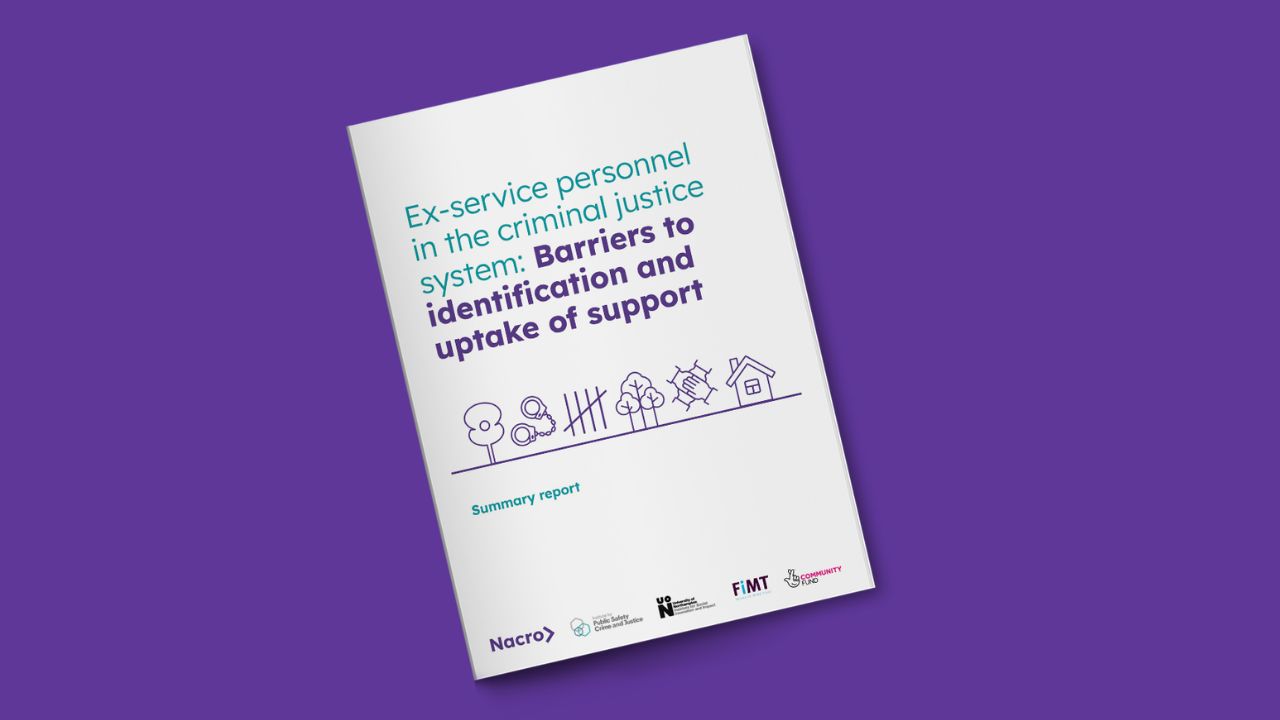
Main report: ‘Ex-service personnel in the criminal justice system: Barriers to identification and uptake of support’
This report explores the strengths and weaknesses of the current identification processes across England, Wales and Scotland, and identifies barriers to uptake of support available to ex-armed service personnel in the criminal justice system. The research team spoke to more than 100 ex-service personnel in contact with the justice system and 100 stakeholders to understand their experiences and the barriers to identification and support.

Video summary: 'Ex-service personnel in the criminal justice system: Barriers to identification and uptake of support' report
This video provides the purpose, goals, and insights from FiMT, Nacro, and the University of Northampton.
Findings
The report sets out the detailed findings across the different stages of the justice system. In addition, there are several themes which emerged across multiple stages. These are:
Stakeholders and ex-service personnel interviewed reported a reluctance of ex-service personnel to seek help before, during, and after contact with the justice system. Pride and a sense of self-reliance were often cited as reasons why ex-service personnel were reluctant to ask for help.
Capacity issues were raised by prison staff in England, Scotland, and Wales, and probation staff in England and Wales, impacting their ability to routinely identify and support ex-service personnel. This was exacerbated by limited knowledge of the most appropriate services for ex-service personnel in the justice system.
Those interviewed often stated that the purpose of identification at different stages of the justice process was not clear. This influences the decision to identify as having served in the Armed Forces, as ex-service personnel were not sure why the question was asked, and what implications it may have on their journey through the justice system.
During our research, it emerged that the term ‘veteran’ was not commonly understood to include ex-service personnel with shorter services and/or no combat experience. Many ex-service personnel were not aware that their service history made them eligible to identify as a ‘veteran’ and seek ex-service personnel specific support services.
The current support landscape is complex, with a considerable number of support options in prison and particularly in the community. However, many of the ex-service personnel who participated in this research and stakeholders were not aware of available support. In addition, many ex-service personnel often stated that they were only aware of ex-service personnel specific services after they had contact with the justice system.
Many stakeholders expressed that ex-service personnel may feel shame concerning their offence and may therefore be reluctant to identify themselves as a former member of the Armed Forces. However, it is important to note that very few ex-service personnel we interviewed expressed shame in this way, or that it prevented them from self-identifying or taking up support.
Recommendations
Our recommendations are informed by the analysis of the evidence collected through this project. To learn more about our recommendations and to read the full report, download your copy here.
Supplementary report: 'Experiences of ex-service personnel before contact with the criminal justice system'
During the course of this research, ex-service personnel told us about their lives and experiences before they came into contact with the criminal justice system. These findings have been analysed and presented in a supplementary report, “Experiences of ex-service personnel before contact with the criminal justice system”. This report was published in February 2026.
Findings published in HM Inspectorate of Probation’s academic insights
Nacro’s findings from in ‘Identification and support for ex-service personnel in the community’ were published in a report for HM Inspectorate of Probation’s academic insights in November 2025.
The academic insights report explores the challenges to identification and support for ex-service personnel, with a focus on those supervised by Probation.
‘Identification and support for ex-service personnel in the community’ HMIP academic insights.

We work in partnership with leading research institutions and other charities to influence and improve policy and practice across criminal justice, health, education and housing. To learn more about this research or discuss collaboration opportunities contact policy@nacro.org.uk